
.svg)


%20(1).png)

Family offices face unique accounting challenges: managing dozens of entities, tracking intercompany flows, handling complex ownership structures, and producing both GAAP-compliant financials and IBOR-based performance reports. Traditional ERP systems like NetSuite or Intacct can be customized to handle some of these needs, but they lack FO-native workflows. Newer entrants like Asseta AI offer a robust offering and modern technology stacks.
This list highlights the top 10 accounting platforms for single family offices (SFOs) and multi-family offices (MFOs) in 2025. It blends purpose-built FO technology with widely adopted ERP and investment solutions that family offices often evaluate.
1. Asseta AI – Comprehensive Family Office Platform
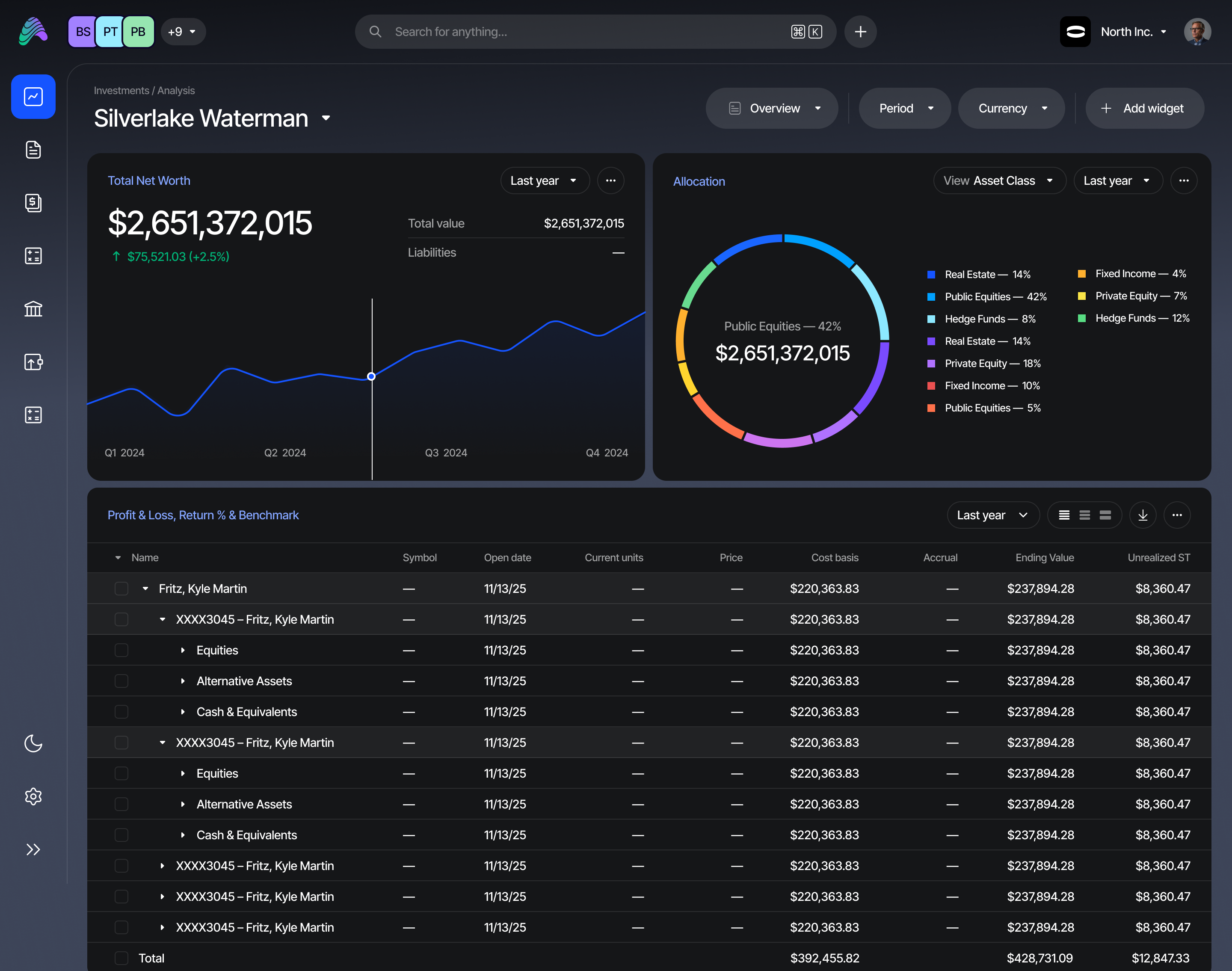
Asseta AI is the only modern platform purpose-built for family office accounting. It provides a multi-entity general ledger, intercompany automation, IBOR vs GAAP reconciliation, and FO-native dashboards for principals. Implementation can be completed in as little as eight weeks, compared to months or years for ERP retrofits. Asseta is perfect for modern family offices with any AUM or number of entities.
- Strengths: AI-powered FO-native workflows, fast implementation, strong data integrations, powerful reporting, family office general ledger.
- Weaknesses: New entrant compared to incumbents (founded 2023).
- Best for: SFOs and MFOs looking to modernize their tech stack and move off QuickBooks, Excel or Intacct.
2. NetSuite – Cloud-Based ERP
NetSuite is one of the most widely used ERPs in the mid-market and is often adopted by larger single family offices that want a scalable backbone. It provides robust multi-entity consolidation, customizable financial modules, and a deep partner ecosystem. However, customization costs are high, and FO-specific features must be built from scratch.
- Strengths: Scalability, global multi-entity accounting, ERP breadth
- Weaknesses: Expensive implementations, no FO-native workflows, overly complex, outdated interface
- Best for: Family offices $5B+ that want institutional-grade infrastructure with inventory heavy operating companies
3. Sage Intacct – Financial Management
Intacct is a popular mid-market financial system with multi-entity consolidation, strong compliance features, and reliable reporting. It is easier to implement than NetSuite and integrates broadly with payroll, bill pay, and CRM systems. However, it still lacks FO-specific features like partnership accounting or capital call tracking.
- Strengths: Strong compliance, integrations, mid-market pricing.
- Weaknesses: Limited FO-native workflows, requires add-ons.
- Best for: SFOs under $1B that want a trusted ERP without going full NetSuite.
4. QuickBooks Enterprise
QuickBooks Enterprise provides a low-cost option for SFOs that have outgrown QuickBooks Online. It supports multiple entities and basic consolidation but lacks the sophistication needed for complex structures. Many FOs use it as a stepping stone before upgrading to FO-native platforms.
- Strengths: Affordable, easy to use, widely available talent pool.
- Weaknesses: Limited consolidation depth, not designed for FOs.
- Best for: <$200M SFOs managing a handful of entities.
5. SEI Archway – MFO Accounting Suite
SEI Archway is a long-standing multi-family office solution that combines accounting, reporting, and bill pay. It is known for its comprehensive functionality but is services-heavy, with long implementations and high costs.
- Strengths: Deep functionality, trusted in the MFO market.
- Weaknesses: Expensive, service-dependent, slower innovation.
- Best for: Established MFOs willing to invest in a full-service solution.
6. Ridgeline – Investment ERP with Accounting
Ridgeline is a newer ERP built by ex-Advent executives, focused primarily on investment management. It includes accounting modules but is more investment-first than FO-first. It’s cloud-native and designed to eventually compete with Aladdin, Archway, and Addepar.
- Strengths: Modern architecture, strong investment focus.
- Weaknesses: Early stage, not proven at scale in FO accounting; not multi-entity.
- Best for: Investment-heavy FOs that want next-gen tech.
7. Investran by FIS – Private Equity Accounting
Investran is a legacy private equity accounting system widely used in PE funds and still adopted by some large FOs. It handles partnership structures, capital calls, and waterfalls but requires heavy customization for FO needs.
- Strengths: PE functionality, trusted for complex structures.
- Weaknesses: Legacy UI, expensive, poor FO workflows.
- Best for: Large FOs with PE-style structures.
8. SS&C Eze – Investment Management Suite
Eze provides accounting, trading, compliance, and risk management in one system. Historically designed for hedge funds, it’s been adopted by some FOs with large investment teams. Accounting functionality exists but is not FO-native.
- Strengths: All-in-one suite, institutional credibility.
- Weaknesses: Complex, expensive, hedge fund DNA.
- Best for: FOs with hedge fund-style operations.
9. eFront by BlackRock – Private Markets Accounting
eFront is a BlackRock-owned solution for private markets and real estate. It provides portfolio analytics, investor reporting, and accounting. It’s enterprise-heavy but effective for FOs with large direct and private portfolios.
- Strengths: Strong PE/RE analytics, backed by BlackRock.
- Weaknesses: Expensive, institutional focus, long implementation.
- Best for: FOs over $1B AUM with private markets exposure.
10. Yardi Investment Suite – Real Estate Accounting
Yardi is a real estate accounting and property management platform that some real estate-heavy FOs adopt. It specializes in property-level accounting, lease management, and RE investment reporting.
- Strengths: Real estate specialization, deep property features.
- Weaknesses: Limited outside of real estate, steep learning curve.
- Best for: Real estate-heavy FOs and family-owned RE portfolios.